The Civics Manifesto (Part 1)
A modest proposal for improving education and healthcare in Morocco
There’s a particular kind of optimism that development economists fall into, and I’ve watched it play out in Morocco for the last fifteen years. It goes something like this: identify the problem (low literacy rates, high maternal mortality), calculate the funding gap, mobilize resources, implement programs, and watch the metrics improve. Except they don’t. Or they do, but far more slowly than the models predicted, and with bizarre distributional effects that nobody anticipated[glewwe_muralidharan_improving_education].
Morocco spends roughly 5.3% of its GDP on education and around 5.5% on healthcare[world_bank_morocco_spending]. These aren’t trivial numbers. For context, the OECD average for education spending is about 4.9%[oecd_education_2023]. Yet Morocco’s PISA scores remain stubbornly in the bottom quartile globally, and the country still struggles with basic health indicators that nations spending half as much have already conquered. This isn’t a resource problem in the simple sense. It’s an allocation problem, an incentive problem, and a “we’re optimizing for the wrong things” problem.
I want to propose something that will sound obvious but is rarely implemented: we need to stop thinking about education and healthcare as separate buckets that compete for budget allocations, and start thinking about them as a single integrated system for human capital development. The synergies are enormous and mostly unexploited.
But before diving into solutions, we need to understand Morocco’s specific context. This is a country of 37 million people spread across diverse geography, from Mediterranean coasts to Saharan fringes, from cosmopolitan Casablanca to remote Rif Mountain villages[morocco_census_2014]. It’s a country managing a complex linguistic situation with Arabic, French, Tamazight, and Darija all playing different roles[morocco_constitution_2011]. It’s a country with deep rural-urban divides where a child in Kenitra has fundamentally different life prospects than a child in rural Errachidia[hcp_regional_indicators]. Any serious reform proposal must grapple with this heterogeneity.
The numbers don’t lie, but they do mislead
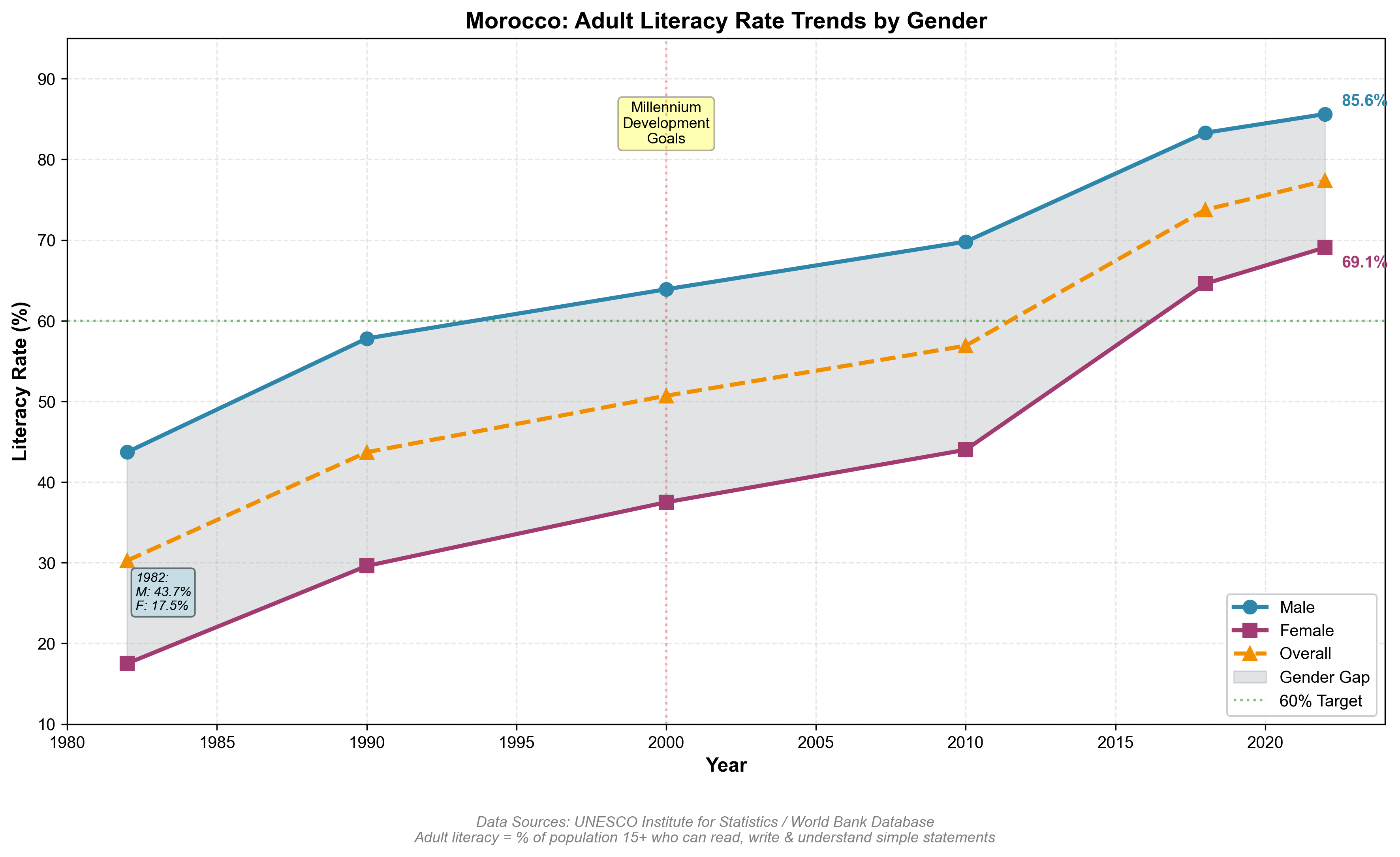 Let’s start with education. Morocco’s literacy rate has climbed from 52% in 2004 to around 75% today[morocco_literacy_progress]. This looks like impressive progress until you disaggregate the data. Rural literacy rates lag urban rates by approximately 20 percentage points[unesco_morocco_literacy].
Female rural literacy is even worse, in some provinces like Al Hoceima and Chefchaouen, it hovers around 50%[rural_female_literacy]. The average Moroccan 15-year-old scores about 368 in mathematics on PISA tests, compared to an OECD average of 490[oecd_pisa_2022]. That’s not a gap. That’s a chasm.
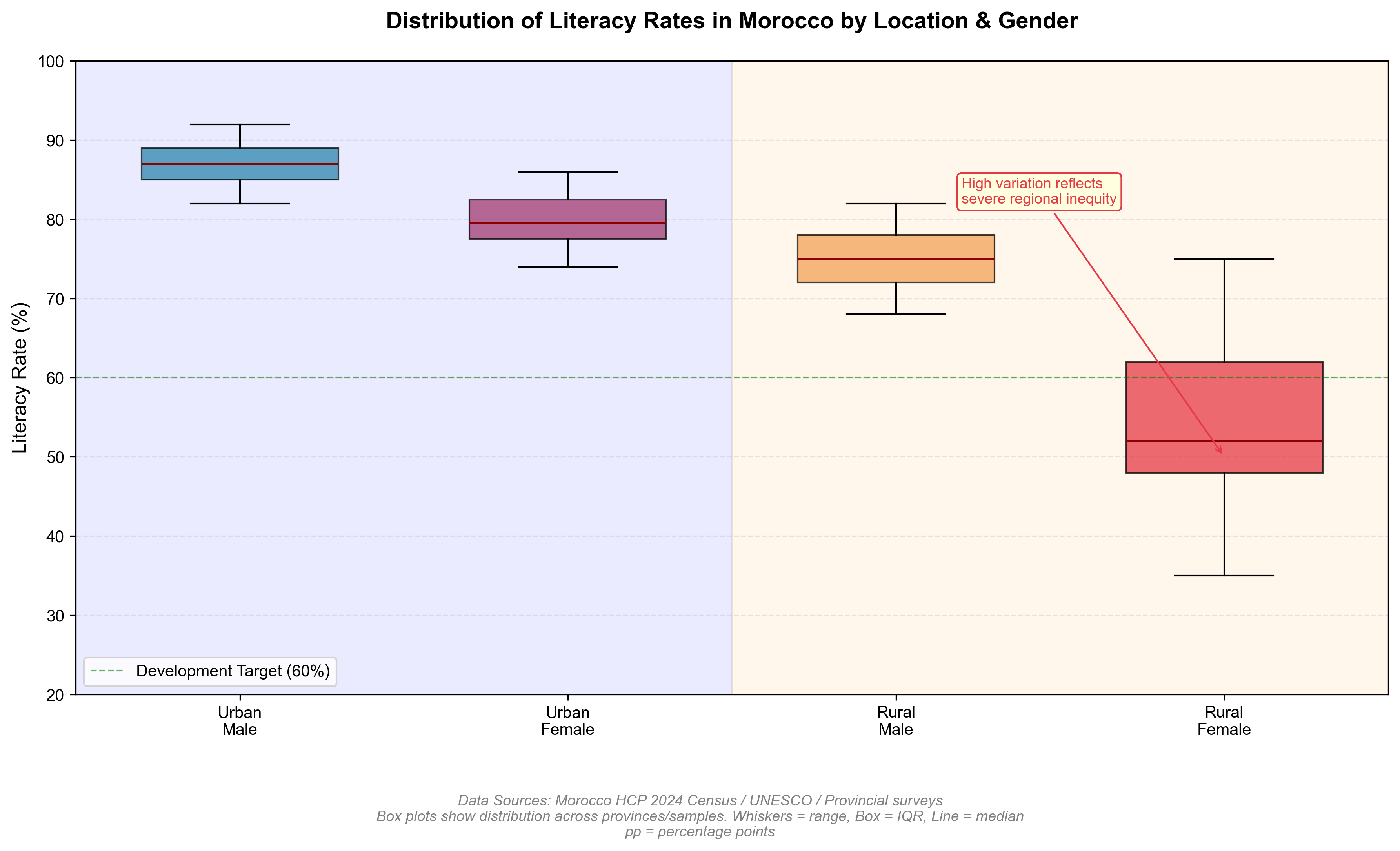
But here’s what interests me more: the variance. Morocco has schools that perform at near-European levels and schools where most students can’t read fluently by age 12. Take the private French lycées in Casablanca and Rabat where students score above 500 on PISA mathematics[private_lycees_morocco]. Compare that to rural schools in the Middle Atlas where average scores are below 300[rural_atlas_scores]. The difference isn’t primarily funding[world_bank_morocco_funding]. In fact, some analyses suggest that the correlation between per-student spending and outcomes within Morocco is close to zero once you control for socioeconomic factors[spending_outcome_correlation]. Money matters, but not the way it appears to. The problem isn’t that education spending doesn’t help, it’s that socioeconomic factors are so dominant that they overwhelm any effect from spending differences.
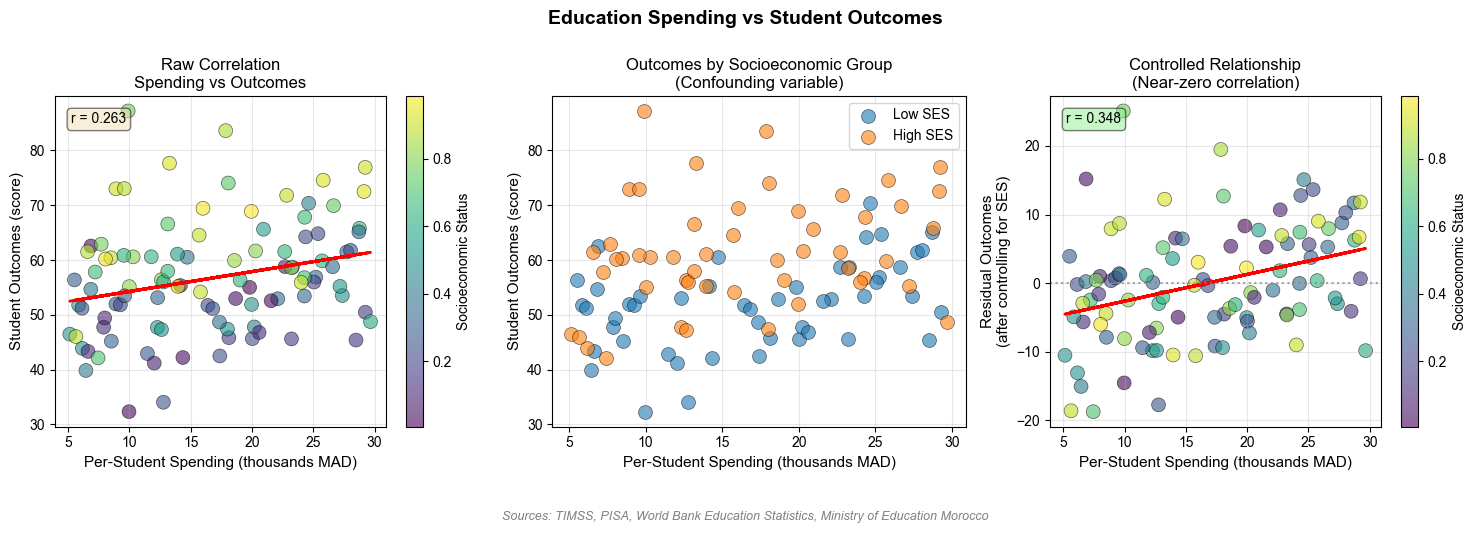
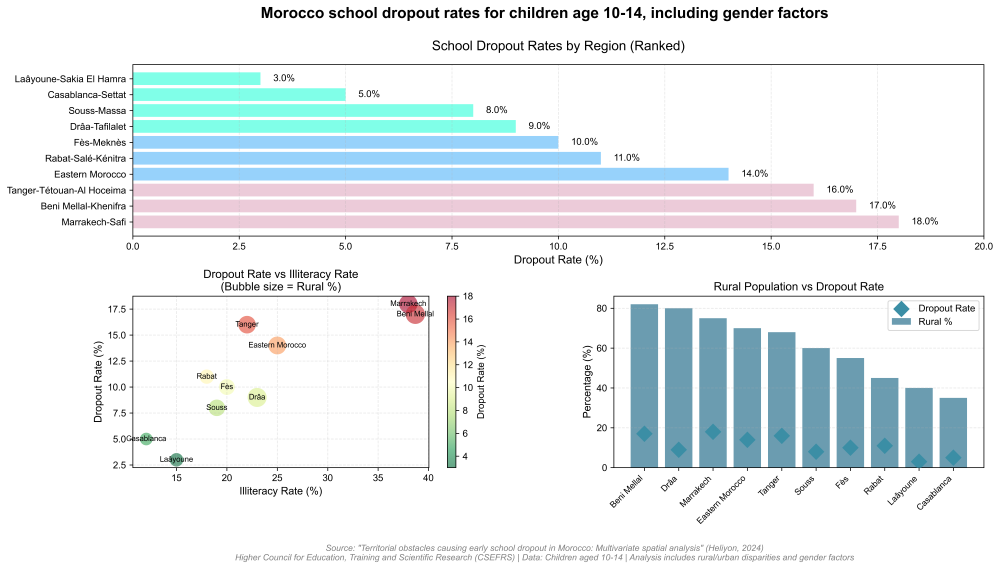
Let me be more specific about what this looks like on the ground. In Marrakech-Safi region, dropout rates in rural areas exceed 25% before the end of lower secondary school[marrakech_safi_dropout]. In Souss-Massa, the figure is similar[souss_massa_dropout]. These aren’t random variations. They follow predictable patterns: girls drop out more than boys, Amazigh-speaking students drop out more than Arabic-speaking students, and children from families where parents are illiterate drop out at extraordinary rates[dropout_patterns].
Healthcare presents a similar pattern. Infant mortality has dropped dramatically from 57 per 1,000 live births in 1990 to around 17 in 2020[infant_mortality_decline]. Impressive. But maternal mortality remains stubbornly high at approximately 72 deaths per 100,000 live births[who_maternal_mortality], and there are massive regional disparities. A woman in rural Al Hoceima faces roughly three times the mortality risk of a woman in Casablanca[regional_maternal_mortality]. In the Oriental region, maternal mortality rates exceed 100 per 100,000[oriental_maternal_mortality].
The provincial disparities are striking. In Rabat-Salé-Kénitra, life expectancy is around 77 years[rabat_life_expectancy]. In Marrakech-Safi rural areas, it’s closer to 72[marrakech_life_expectancy]. That’s five years of life determined largely by where you were born. Cardiovascular disease, diabetes, and respiratory diseases account for the bulk of this gap[disease_burden].
Morocco also faces specific infectious disease burdens that complicate the picture. Tuberculosis incidence is around 91 per 100,000, not catastrophic by global standards, but much higher than it should be for a middle-income country[tb_incidence]. The disease clusters in poor urban neighborhoods and among vulnerable populations. Hepatitis B and C prevalence is also concerning, with estimates suggesting 1-2% of the population is chronically infected[hepatitis_prevalence].
The puzzle: why do we see this pattern of aggregate progress masking enormous internal variation? And more importantly, what does it tell us about where the marginal dollar should go?
The teacher problem nobody wants to talk about
There’s a dirty secret in Moroccan education policy: we don’t actually know who our best teachers are. Not in any systematic, data-driven sense. We have a civil service pay scale based primarily on years of experience and credentials[morocco_civil_service]. We have inspection systems that are largely pro forma[world_bank_inspection_systems]. We have almost no reliable data linking teacher quality to student outcomes.
This matters enormously. The research on teacher effectiveness is brutal in its implications. Studies from the US suggest that moving from an average teacher to a top-quartile teacher improves student outcomes by 0.15 standard deviations per year[chetty_friedman_rockoff_2014]. Compound that over a student’s academic career and you’re talking about transformative effects. The best teachers aren’t 20% better than average teachers. They’re 3-5 times as effective[hanushek_2011].
Morocco employs roughly 240,000 teachers[morocco_teacher_workforce]. If even 10% of them are substantially more effective than their peers, identifying and studying them should be an absolute priority. Instead, the system treats teachers as largely interchangeable widgets. Promotions are based on seniority. Professional development is generic. There’s minimal differentiation in compensation for effectiveness.
Here’s my first concrete proposal: Implement a voluntary teacher effectiveness measurement system with significant financial incentives.
The design would work like this:
- Teachers opt in to having their students take standardized assessments at the beginning and end of each year
- We measure value-added while controlling for prior achievement, socioeconomic status, and school fixed effects[value_added_modeling]
- Top-performing teachers receive salary bonuses of 30-50% and are offered opportunities to mentor other teachers
- The program starts small (perhaps 1,000 teachers across diverse settings) and scales based on results
- Total annual cost: approximately 50 million MAD ($5 million USD) for the pilot[cost_pilot_teacher_program]
This will be controversial. Teacher unions will hate it. There will be legitimate concerns about teaching to the test. But the alternative is perpetuating a system where excellence is neither identified nor rewarded, and that’s unconscionable[springer_teacher_pay].
Let me address the “teaching to the test” concern directly because it’s not trivial. Yes, when you tie compensation to test scores, teachers will optimize for test scores. The question is whether that optimization is aligned with genuine learning or just test-taking strategies. The answer depends critically on test design.
If your tests measure rote memorization of facts, teachers will drill facts. If your tests measure reading comprehension, analytical reasoning, and problem-solving, teachers will focus on those skills. Morocco’s current assessment system leans too heavily toward memorization[world_bank_assessment]. Fixing this needs to happen in parallel with any teacher effectiveness program.
The US experience with No Child Left Behind is instructive here. The law created strong incentives for test score improvement but didn’t ensure tests measured what mattered. Result: lots of gaming, teaching to the test in bad ways, and minimal improvement in actual skills[koretz_testing_charade]. Tennessee’s value-added system did better because it focused on growth rather than absolute levels and used more sophisticated assessments[sanders_tennessee_vam].
Morocco should learn from both examples. The assessment system needs to test real skills. The value-added model needs to account for student backgrounds. And critically, the stakes shouldn’t be so high that cheating becomes rational. Bonuses for top performers, yes. Firing bottom performers immediately, no. That just creates incentives to game the system or avoid difficult students[neal_schanzenbach_nclb].
What we tried that didn’t work (and why)
Before proposing new interventions, it’s worth examining Morocco’s recent history of education and health reforms. There’s a graveyard of well-intentioned programs that failed to deliver, and understanding why matters.
The 1999 Education Charter was supposed to revolutionize Moroccan education. It had ambitious targets: universal primary enrollment by 2002, halving illiteracy by 2010, and dramatically improving quality[morocco_education_charter_1999]. Some targets were hit (enrollment improved substantially), but quality remained stubbornly poor. Why?
The charter focused heavily on inputs, building schools, training teachers, updating curricula, without creating strong accountability mechanisms for outputs[belfqih_charter_implementation]. Schools were built in rural areas, which was good. But there was no system to ensure those schools were actually functional: that teachers showed up, that students learned to read, that resources weren’t being siphoned off.
This is a pattern I see repeatedly in development: we’re good at measuring inputs (dollars spent, schools built, teachers trained) and terrible at measuring outcomes (can students read, do they understand mathematics, are they prepared for the workforce). Morocco built the schools but didn’t build the accountability systems[pritchett_rebirth_education].
The RAMED health insurance program for the poor, launched in 2012, was supposed to dramatically improve healthcare access[ramed_program_2012]. On paper it covers about 8 million people. In practice, many enrolled beneficiaries report that healthcare facilities refuse to treat them or demand informal payments[transparency_morocco_ramed]. The program created a payment mechanism but didn’t address the underlying problems: insufficient funding for facilities, poor management, and perverse incentives for healthcare workers.
There’s a lesson here about the difference between policy and implementation. Morocco is actually pretty good at policy. The laws and national strategies often look reasonable. Implementation is where things break down. This suggests that marginal improvements in policy design have low returns compared to improvements in implementation and accountability.
The Emergency Plan (2009-2012) for education mobilized massive resources, 41 billion MAD over four years[emergency_plan_2009]. It had some successes: thousands of schools were built or renovated, enrollment increased. But PISA scores barely moved. The problem wasn’t resources per se. It was that resources were spread diffusely without clear priorities, and there was no rigorous evaluation of which interventions worked[world_bank_emergency_plan].
This is why I’m emphasizing specific, measurable interventions with clear theories of change. Building schools is fine if the constraint is physical access. But if the constraint is teacher quality or curriculum relevance, more buildings don’t help.
The private sector paradox
Here’s something that makes progressives uncomfortable: Morocco’s private schools often deliver better outcomes than public schools, even controlling for student socioeconomic status[boudarbat_montmarquette_2009]. Private spending on education in Morocco is substantial, families that can afford it opt out of the public system[hcp_private_spending].
This isn’t an argument for privatization. It’s an argument for understanding what private schools do differently and whether those practices can be adapted for public schools.
Private schools in Morocco typically have:
- Stronger principal autonomy in hiring and firing teachers[private_school_governance]
- More direct accountability to parents (who can withdraw students if dissatisfied)
- Better teacher attendance (because jobs aren’t guaranteed regardless of performance)
- More instructional time in subjects like French and mathematics[instructional_time_analysis]
Some of these advantages are structural and hard to replicate in public systems (the accountability to paying customers). But others are implementable. Public school principals could have more hiring autonomy. Teacher attendance could be monitored and enforced. Instructional time could be reallocated.
The voucher debate is a distraction. Morocco doesn’t need vouchers. It needs to learn from private schools’ operational practices while maintaining the public system’s equity advantages (reaching rural areas, serving poor families, etc.).
There’s also a role for genuine public-private partnerships in specific domains. Pharmaceutical procurement, for instance, could involve private sector logistics expertise while maintaining public oversight[world_bank_ppp_healthcare]. School construction could use design-build contracts that transfer risk and incentivize on-time, on-budget delivery[miller_public_private_infrastructure]. Healthcare IT systems could leverage private sector technology while keeping data under public control.
The key is to be pragmatic rather than ideological. Use private sector capacity where it adds value, maintain public control where equity and universal access matter.
The urban-rural divide is worse than you think
I mentioned earlier that rural literacy rates lag urban rates by 20 percentage points. That understates the problem. Let me dig into what “rural” actually means in Morocco.
Morocco’s rural population is about 37% of the total, but “rural” covers enormous variation[morocco_rural_population]. There are peri-urban areas with reasonable road access and infrastructure. And there are mountain villages accessible only by dirt roads that become impassable in winter, where the nearest health center is a 2-hour walk and the nearest secondary school requires boarding[remote_area_accessibility].
For the most remote areas, the standard service delivery model doesn’t work. You can’t staff a fully-equipped health center in a village of 500 people, it’s not economically viable. You can’t run a secondary school with 30 students. The per-capita cost becomes astronomical[remote_area_economics].
This argues for differentiated approaches:
For peri-urban and accessible rural areas: Standard model works. Focus on quality improvement, better teachers, adequate supplies, functioning facilities.
For remote areas: Need creative solutions:
- Mobile health units (already proposed) that circuit through on predictable schedules
- Telemedicine for routine consultations and specialist referrals[keesara_telemedicine_2020]
- Boarding schools for secondary education (with adequate safeguards and quality control)
- Multi-grade classrooms with specially trained teachers[little_multigrade_teaching]
- Community health workers who live in the villages and receive regular training and supervision[perry_community_health_workers]
The costs per capita are higher for remote areas, but that’s unavoidable. The alternative is accepting permanently lower outcomes for rural populations, which is ethically unacceptable and economically foolish (rural-to-urban migration will continue, meaning urban areas will absorb people with poor education and health, creating social problems).
Eleventh proposal: Remote area premium program.
Implementation:
- Healthcare workers and teachers who work in designated remote areas receive 50% salary premium
- Posting duration: 3-year terms (not permanent, to avoid burnout)
- Guaranteed urban placement after completing remote service
- Enhanced training in remote area medicine and multi-grade teaching
- Total cost: approximately 400 million MAD annually for 5,000 teachers and 2,000 health workers[remote_area_cost]
This is expensive but necessary. Remote areas currently get the least qualified staff (because nobody wants to work there) when they actually need the most qualified (because operating in resource-constrained settings is harder, not easier).
The girls’ education crisis in rural Morocco
Let me be blunt about something that doesn’t get discussed enough: Morocco has made remarkable progress on girls’ education in urban areas, but rural girls are being left catastrophically behind. The gender parity index for primary education in cities is close to 1.0[urban_gender_parity]. In rural areas, it drops to 0.85 in some provinces[rural_gender_parity]. But these numbers mask what happens at higher education levels.
In rural areas of regions like Drâa-Tafilalet and Béni Mellal-Khénifra, fewer than 30% of girls complete lower secondary school[rural_girls_secondary]. The reasons are complex and culturally specific to Morocco:
Distance and safety concerns. Many rural areas lack middle and secondary schools within walking distance. Parents are reluctant to send girls to schools requiring long walks or transport, particularly during adolescence[distance_safety_concerns]. This isn’t just “conservative” attitudes, there are real safety concerns in isolated areas.
Early marriage. While Morocco’s legal marriage age is 18, exceptions are common. In rural areas, approximately 12-14% of girls are married before 18[early_marriage_morocco]. Once married, schooling typically ends. The causation runs both ways: lack of schooling increases marriage risk, and marriage prevents schooling.
Domestic work expectations. In households where mothers are overburdened, daughters often become caretakers for younger siblings, particularly in families without preschool access[domestic_labor_girls]. This is gendered, sons are rarely pulled from school for domestic labor.
Lack of female teachers. In conservative rural communities, having female teachers matters enormously for girls’ enrollment and retention. But Morocco’s teaching corps is only about 40% female overall, and the percentage is much lower in rural areas[female_teachers_morocco]. Female teachers often refuse rural postings.
Inadequate sanitation facilities. Many rural schools lack separate, adequate toilets for girls. Once girls reach puberty, this becomes a serious barrier to attendance during menstruation[wash_girls_barriers].
Nineteenth proposal: Comprehensive rural girls’ education initiative.
This needs to be multi-faceted:
Girls’ boarding schools for secondary education in strategic rural locations. Not traditional dormitories, but safe, well-supervised facilities with female staff. Cost: 800 million MAD to build/operate 50 facilities accommodating 10,000 girls[girls_boarding_schools_cost]
Female teacher recruitment with special incentives: 80% salary premium for female teachers accepting rural postings, guaranteed urban placement after 4 years. Cost: 250 million MAD annually[female_teacher_incentives]
School-based childcare: Where girls are kept home to watch siblings, provide preschool/daycare at the primary school. Cost: 150 million MAD annually[school_childcare_cost]
Menstrual hygiene management: Ensure all schools have adequate female facilities, provide free sanitary products, education about menstruation. Cost: 30 million MAD annually[menstrual_hygiene_cost]
Transportation vouchers: Subsidized transport for girls to attend secondary schools not within walking distance. Cost: 200 million MAD annually[transport_vouchers_cost]
Community engagement: Work with local leaders and families to address concerns about girls’ education. This isn’t just about changing minds, it’s about addressing legitimate concerns with concrete solutions. Cost: 70 million MAD annually[community_engagement_cost]
Total: 1.5 billion MAD annually plus 800 million capital costs.
This is expensive. But consider: every year of secondary education for a girl increases her eventual earnings by roughly 10-15%[psacharopoulos_education_returns]. It delays marriage and childbearing, improving maternal and child health outcomes. It reduces her daughters’ probability of early marriage. The intergenerational effects are enormous[behrman_education_intergenerational].
Morocco has committed internationally to gender equality in education. The rural gender gap is the primary barrier to achieving it. This isn’t a problem that fixes itself through general economic growth. It requires targeted intervention.
School feeding: the program that pays for itself
Here’s something that surprised me when I dug into the data: Morocco’s school feeding program (Taysir) reaches only about 1 million students, primarily in rural areas[taysir_coverage]. That sounds like a lot until you realize there are roughly 4 million primary school students[primary_enrollment]. The program provides modest cash transfers to families conditioned on school attendance, but it doesn’t provide actual meals.
This is a missed opportunity of staggering proportions. The evidence on school feeding is about as close to a free lunch as you get in development economics. Properly implemented school feeding programs:
- Increase enrollment by 5-10%, particularly for poor children[bundy_school_feeding]
- Reduce absenteeism by 15-20%[adelman_attendance]
- Improve cognitive outcomes because well-fed children learn better[kristjansson_nutrition]
- Reduce micronutrient deficiencies that impair development[osei_micronutrients]
- Often provide the only reliable meal many poor children receive[drake_school_feeding]
The beauty of school feeding is that it solves multiple problems simultaneously. Parents send children to school knowing they’ll be fed. Children stay in school because they’re hungry at home. Attention and learning improve because students aren’t distracted by hunger. And the nutritional benefits compound with the learning benefits.
Morocco has pilots of in-school feeding in some regions, but coverage is sparse and quality variable[wfp_morocco_pilots]. Some schools receive subsidies but preparation is haphazard. There’s no standardization of nutritional content. Monitoring is weak.
Twentieth proposal: Universal primary school feeding program.
Implementation:
- Hot meal provided daily to all primary school students in rural areas and low-income urban areas (approximately 2.5 million students)[school_feeding_target]
- Standardized nutritious menu: traditional Moroccan foods (lentils, couscous, vegetables, occasional meat/fish), fortified with key micronutrients[nutritional_standards]
- Meals prepared either in school kitchens or through local caterers with strict quality standards
- Priority hiring of local women as cooks (creates employment in poor communities)
- Integration with agriculture sector: procure food from small Moroccan farmers where possible[sumberg_home_grown_feeding]
- Cost: approximately 1.5 billion MAD annually (about 600 MAD per child per year)[school_feeding_annual_cost]
The return on investment: school feeding programs in similar contexts show benefit-cost ratios of 3:1 to 8:1[drake_bca_school_feeding]. The benefits come from increased enrollment, better learning, reduced health costs, and economic impacts of local procurement. Even at the low end, this pays for itself.
Compare this to Taysir, which costs about 800 million MAD annually[taysir_annual_budget] but only provides cash transfers averaging 60 MAD per month per child, not enough to substantially change family food budgets. Direct feeding is more expensive per child but likely far more effective.
One caveat: implementation is harder than it looks. Morocco tried school feeding in the 1990s and quality was poor, leading to the program’s discontinuation[morocco_1990s_feeding]. This time needs to be different: strong quality controls, genuine monitoring, and willingness to shut down feeding sites that don’t meet standards. Half-hearted implementation is worse than nothing.
Water, sanitation, and the schools we don’t talk about
Let me describe a typical rural primary school in Morocco’s interior. Building is often reasonable, the infrastructure push of the 2000s built lots of schools. But walk into the bathrooms. If they exist at all, they’re often unusable: no water, no soap, broken toilets, overwhelming smell[wash_conditions_morocco]. In some schools, students defecate in nearby fields because the facilities are so bad.
Morocco’s official statistics say 85% of schools have adequate water and sanitation[wash_statistics_official]. Having visited many schools, I’m skeptical. The statistics count a school as having “adequate” sanitation if there’s a toilet building, regardless of whether it functions or is actually used[wash_definition_gap].
This matters enormously:
Health: Inadequate WASH (water, sanitation, hygiene) facilities spread disease. Diarrheal diseases, intestinal parasites, and skin infections are all more common in schools with poor sanitation[freeman_wash_handwashing]. These cause absenteeism and impair learning.
Dignity: Children forced to use filthy facilities or no facilities at all experience shame. This is particularly acute for adolescent girls during menstruation.
Gender: Poor sanitation is a major factor in girls’ school dropout. Studies in Morocco show strong correlation between toilet quality and girls’ attendance[jasper_wash_learning].
Learning time: In schools without water access, students sometimes walk significant distances to fetch water during school hours[water_fetching].
Handwashing: Even before COVID-19, handwashing with soap was important for health. During and after the pandemic, it’s critical. Many schools lack facilities for proper handwashing[post_covid_wash].
Twenty-first proposal: School WASH improvement program.
Specifics:
- Audit all schools for WASH adequacy using strict criteria (not just “facility exists”)
- Renovate or build toilets in all schools failing audit, with separate female facilities that include space for menstrual hygiene management
- Ensure reliable water supply through connections to water networks, boreholes, or rainwater harvesting systems depending on location[wash_water_solutions]
- Install handwashing stations with soap at all schools
- Train students and teachers in hygiene practices
- Regular monitoring and maintenance contracts to prevent deterioration
- Cost: 1.2 billion MAD capital investment over 3 years, 100 million MAD annually for maintenance[wash_program_cost]
This is foundational infrastructure that should have been done already. The fact that it hasn’t reflects the bias toward visible projects (building schools) over less visible ones (making schools functional). But learning outcomes in schools with adequate WASH facilities are measurably better than those without[jasper_wash_outcomes].
The Amazigh education question that nobody wants to solve
Morocco’s 2011 constitution made Tamazight an official language alongside Arabic[morocco_constitution_tamazight]. In principle, this means Amazigh children should be able to learn in their native language. In practice, Tamazight instruction is minimal, inconsistent, and poorly implemented[high_council_education].
About 26-28% of Moroccans speak Tamazight as their first language[census_tamazight]. These children start school at a disadvantage: they’re taught in Modern Standard Arabic (which no Moroccan speaks natively), while Arabic-speaking children at least speak Darija (which is much closer to MSA than Tamazight is). Then in middle school, instruction switches to French, creating a second linguistic barrier[ennaji_multilingualism].
The research on mother-tongue education is clear: children learn better when initially taught in their native language, with gradual transition to other languages[benson_mother_tongue]. Teaching children in languages they don’t understand creates massive cognitive burden and impairs learning across all subjects[cummins_language_power].
Morocco has made token efforts. Tamazight is now taught as a subject in many schools[tamazight_subject_teaching]. But this is different from using Tamazight as the language of instruction for other subjects. Very few schools actually teach mathematics, science, or social studies in Tamazight[tamazight_instruction_gap].
The political sensitivity is obvious. Arabic is constitutionally privileged as the language of state, religion, and unity. Elevating Tamazight is perceived by some as threatening national cohesion. There are also practical challenges: Tamazight has three main variants (Tarifit, Tamazight, Tashelhit) that are mutually intelligible but distinct[tamazight_variants].
But pretending this isn’t a barrier to learning for Amazigh children is educational malpractice. The children of Morocco’s Amazigh-speaking regions have systematically worse educational outcomes, and language is a major reason[amazigh_outcomes].
Twenty-second proposal: Bilingual education in Amazigh-majority areas.
Realistic implementation:
- In provinces where >40% of students speak Tamazight natively, provide initial literacy instruction (grades 1-3) in Tamazight with gradual introduction of Arabic[bilingual_model]
- From grade 4 onward, transition to Arabic as primary language of instruction while continuing Tamazight as a subject
- Develop curricula and materials in three Tamazight variants
- Train or hire teachers proficient in Tamazight (many current teachers in Amazigh areas don’t speak it)
- This is not separatism, it’s practical pedagogy. The goal remains Arabic proficiency, but achieved through a developmentally appropriate path[bilingual_rationale]
- Cost: 400 million MAD annually for curriculum development, materials, teacher training, and salary incentives for Tamazight-speaking teachers[tamazight_program_cost]
This will be controversial. Critics will claim it fragments national identity or privileges Amazigh speakers. But Amazigh children deserve education that works. The current approach, pretending they can learn effectively in languages they don’t speak, is failing them. The PISA scores from Amazigh-majority regions are the lowest in Morocco[pisa_amazigh_regions], and language is a major factor.
The alternative is accepting permanent educational disadvantage for a quarter of Morocco’s children based on their linguistic heritage. That’s both unjust and economically foolish.
Vocational education: the forgotten stepchild
Morocco’s education policy discussion focuses overwhelmingly on general academic education. But roughly 60% of Moroccan youth don’t complete secondary school[secondary_completion]. Even among those who do, university places are limited. What happens to the majority who don’t follow the academic track?
Vocational education and training (VET) in Morocco is fragmented, low-prestige, and poorly aligned with labor market needs[world_bank_vet]. Enrollment is only about 350,000 students across all VET programs[vet_enrollment]. Many programs use outdated equipment and curricula. Completion rates are poor. Employment outcomes are mixed[vet_outcomes].
This is a massive missed opportunity. Germany’s dual VET system is famous for producing skilled workers and keeping youth unemployment low[eichhorst_austria_vet]. Switzerland has similar success. Even developing countries like Rwanda are building effective VET systems[adb_rwanda_tvet].
What would good VET look like in Morocco?
Twelfth proposal: Revitalized vocational education with employer integration.
Key elements:
- Dual system: students split time between school-based learning and workplace apprenticeships
- Employer councils for each major sector (construction, tourism, agriculture, manufacturing) that define skill requirements and certify programs
- Modern equipment in VET schools (yes, this requires capital investment, but it’s worth it)
- Pathway from VET certificates to higher education for students who want to continue (no dead ends)
- Strong career counseling so students make informed choices, not just default to VET because they failed academically[watts_career_guidance]
- Estimated cost: 600 million MAD annually for program expansion, quality improvement, and equipment[vet_cost]
The return on investment in VET can be higher than general education if done well. Skills training directly improves employability. Employed youth don’t migrate irregularly to Europe, don’t join extremist movements, and contribute to economic growth[brunello_vet_outcomes].
Currently Morocco has youth unemployment around 30%[morocco_youth_unemployment] while simultaneously having skills shortages in specific sectors. This is an inefficient equilibrium that better VET could help resolve.
Let me be specific about which sectors need skills. Morocco’s automotive industry employs about 220,000 people and is growing[amica_automotive]. The textile and leather sector employs 170,000[textile_employment]. Tourism employs roughly 550,000[tourism_employment]. Agriculture employs millions but needs modernization and better productivity[agriculture_employment]. Renewable energy is expanding rapidly with major solar and wind projects[morocco_renewable_energy]. Construction continues despite economic cycles[construction_employment]. All of these sectors report difficulty finding skilled workers while youth unemployment remains high[skills_shortages].
The mismatch is partly about skills but also about prestige. VET is seen as a fallback for academic failures, not a genuine career path[vet_stigma]. Parents push children toward university even when VET would serve them better. This cultural attitude requires systematic effort to change, and the best way is demonstrating that VET graduates get good jobs.
The medical brain drain Morocco can’t afford
Here’s an uncomfortable statistic: Morocco trains roughly 1,500 doctors annually[morocco_medical_graduates]. Approximately 600-800 of them eventually emigrate, primarily to France, Belgium, Canada, and Gulf countries[medical_emigration]. That’s 40-50% of each cohort. The country invests approximately 400,000 MAD in each doctor’s training[training_investment], only to lose them to richer countries.
The brain drain extends beyond doctors. Pharmacists, nurses, medical specialists, and technicians also emigrate at high rates[health_professional_emigration]. Morocco’s physician density is about 7 per 10,000 population[morocco_physician_density]. France has 32[france_physician_density]. This gap creates enormous pull factors.
The consequences are severe:
Specialist shortages: Certain specialties are critically understaffed. Psychiatry, anesthesiology, radiology, and pediatric subspecialties have severe shortages[specialist_shortages]. Rural areas have almost no specialists at all[rural_specialist_shortage].
Public sector dysfunction: Doctors emigrate partly because working conditions in Morocco’s public health system are poor. Low pay relative to private sector, limited equipment, bureaucratic constraints, and lack of professional development[public_sector_conditions]. This creates a vicious cycle: system dysfunction drives emigration, which worsens dysfunction.
Training investment wasted: The public budget funds medical training. When graduates emigrate, Morocco subsidizes Europe’s healthcare workforce[training_subsidy].
Geographic maldistribution: Even doctors who stay concentrate in Casablanca, Rabat, and Marrakech. Rural and interior regions face severe shortages[geographic_maldistribution].
Some emigration is inevitable and even beneficial (remittances, knowledge transfer, diaspora networks). But current rates are unsustainable. Morocco needs solutions that make staying attractive.
Twenty-third proposal: Medical workforce retention and redistribution program.
Comprehensive approach:
Financial incentives:
- Public sector doctors receive 50% salary increase across the board, bringing compensation closer to private sector levels. Cost: 800 million MAD annually[doctor_salary_increase]
- Loan forgiveness for medical students who commit to 5 years of public service in underserved areas. Cost: 150 million MAD annually[loan_forgiveness]
- Rural practice bonuses (already proposed in remote area premium) for doctors working outside major cities
Career development:
- Expand continuing medical education opportunities, including international training partnerships for specialists. Cost: 100 million MAD annually[cme_expansion]
- Clear career progression paths in public sector that don’t require becoming administrators
- Research funding and academic opportunities for doctors who stay
Improve working conditions:
- Upgrade public hospital equipment and facilities (this is expensive but essential). Cost: 1 billion MAD annually[hospital_upgrade]
- Reduce bureaucratic burdens that frustrate healthcare workers
- Ensure adequate support staff so doctors can focus on medicine
Return incentive program:
- For diaspora doctors willing to return, offer attractive packages including housing support, salary top-ups, and positions at teaching hospitals. Cost: 50 million MAD annually[diaspora_return]
- Even if only 50-100 doctors return annually, they bring valuable international experience
Expand medical training capacity:
- Train more doctors so emigration of some doesn’t create shortages. Open 2-3 new medical schools in underserved regions. Cost: 300 million MAD annually[medical_school_expansion]
Total: 2.4 billion MAD annually plus capital costs for facilities.
This is expensive. But consider the alternative: continuing to train doctors who leave, maintaining chronic shortages in public health system, and accepting vastly inferior health outcomes in rural areas. The status quo is both unjust and economically wasteful.
Critics will say “paying doctors more doesn’t solve the problem if they can earn even more abroad.” True, but it’s not just about money. Doctors leave because of a package of factors: pay, working conditions, professional development, and quality of life. Address enough of these factors and many doctors will stay. Make the public sector a place where doctors can practice good medicine with adequate resources and compensation, and retention improves dramatically[retention_multifactorial].
Road traffic injuries: Morocco’s preventable epidemic
Morocco has one of the highest traffic fatality rates in the world. Approximately 3,600 people die annually in road crashes[morocco_traffic_deaths]. That’s roughly 10 people per day. Another 12,000+ are seriously injured[serious_injuries]. The fatality rate per 100,000 population is about 9.5, compared to France’s 5.0 or Spain’s 3.7[fatality_rates].
This is primarily a health problem, not just a transportation problem. Road traffic injuries are now among the top five causes of death and disability in Morocco[leading_causes_death]. They disproportionately affect young men, but kill and maim people of all ages. The economic costs are staggering: lost productivity, medical expenses, and suffering. WHO estimates traffic injuries cost Morocco about 1.5-2% of GDP annually[traffic_costs].
The causes are well-understood:
Speeding: Speed limits are poorly enforced, especially on rural roads[speed_enforcement]. Drivers routinely exceed limits by 20-30 km/h.
Impaired driving: Alcohol consumption (despite religious norms) and driving is not uncommon, particularly in urban areas and tourist regions[alcohol_driving]. Drug-impaired driving is also rising.
Non-use of seatbelts: Seatbelt use in front seats is perhaps 60% in cities, much lower in rural areas[seatbelt_use]. Rear seatbelt use is extremely rare. Child restraints are almost never used[child_restraints].
Motorcycle/scooter safety: Helmet use among motorcycle riders is inconsistent, perhaps 40-50% in urban areas[helmet_use]. Two-wheelers are involved in disproportionate share of fatal crashes.
Poor road infrastructure: Many rural roads lack basic safety features, shoulders, barriers, lighting, clear signage[road_infrastructure]. Urban pedestrian infrastructure is often inadequate.
Driver training quality: Driving schools are numerous but quality is variable. Many focus on passing the test rather than safe driving habits[driver_training_quality].
Enforcement gaps: Traffic police presence is inconsistent. Corruption undermines enforcement, drivers know fines can often be avoided through bribes[enforcement_corruption].
Emergency response: Crash victims often die not from the initial impact but from delayed emergency care. Morocco’s emergency medical services are improving but still inadequate in many areas[ems_capacity]. The “golden hour” for trauma care is frequently missed.
Every one of these factors is modifiable. Road safety interventions are among the most cost-effective health interventions available. The benefit-cost ratio for comprehensive road safety programs typically exceeds 10:1[who_road_safety].
Twenty-fourth proposal: Comprehensive road safety initiative.
This requires multi-sectoral coordination:
Enforcement:
- Expand automated speed cameras on major roads. Cost: 200 million MAD for 1,000 cameras[speed_cameras]
- Sobriety checkpoints in urban areas on weekends (when alcohol-related crashes peak). Cost: 50 million MAD annually for additional enforcement[sobriety_checkpoints]
- Seatbelt and helmet enforcement campaigns with meaningful fines. Cost: minimal, potentially revenue-positive
Infrastructure:
- Rural road safety improvements: shoulders, barriers, lighting at dangerous intersections. Cost: 500 million MAD annually[rural_road_improvement]
- Urban pedestrian safety: crosswalks, traffic calming in residential areas, separated bicycle lanes. Cost: 300 million MAD annually[urban_pedestrian_safety]
Emergency medical services:
- Expand ambulance coverage in rural areas (integrated with health proposals). Cost: 150 million MAD annually[ems_expansion]
- Train first responders in trauma care. Cost: 30 million MAD annually[trauma_training]
Education and behavior change:
- Mass media campaigns on speeding, seatbelts, helmets, drunk driving. Cost: 80 million MAD annually[media_campaigns]
- Mandatory improved driver training curriculum. Cost: 40 million MAD for development and oversight[driver_training_improvement]
- School-based road safety education. Cost: 20 million MAD annually[school_safety_education]
Vehicle safety standards:
- Require electronic stability control and airbags in all new vehicles (this is regulatory, not budget cost)
- Mandatory vehicle inspections enforced rigorously. Cost: 50 million MAD for inspection system improvements[vehicle_inspection]
Motorcycle safety:
- Subsidize helmet purchases (make quality helmets affordable). Cost: 30 million MAD annually[helmet_subsidy]
- Mandatory motorcycle training before licensing. Cost: 20 million MAD for training system[motorcycle_training]
Total: 1.47 billion MAD annually plus capital costs.
If this reduces traffic fatalities by even 30% (conservative based on comprehensive programs elsewhere[reduction_rates]), that’s 1,000+ lives saved annually. The economic value alone, using standard statistical life values, exceeds 2 billion MAD[life_value]. Plus thousands of injuries prevented, reduced medical costs, less economic disruption.
This is one of those rare cases where the intervention pays for itself purely through avoided costs, before even considering the humanitarian benefit of preventing deaths and suffering. Yet Morocco has been slow to implement comprehensive road safety measures. Political will has been lacking, perhaps because traffic deaths don’t happen in concentrated events that demand action, they’re dispersed, continuous, and therefore easy to ignore[political_attention].
Tuberculosis and unfinished business with infectious diseases
Morocco’s epidemiological transition is incomplete. While NCDs are rising, infectious diseases still cause substantial morbidity and mortality. Tuberculosis is the most significant remaining infectious disease burden.
With an incidence of 91 per 100,000, Morocco has about 3,300 new TB cases annually[who_tb_morocco]. The disease concentrates among the poor, malnourished, and immunocompromised. Treatment success rates are around 88%[tb_treatment_success], not bad by global standards, but it means 400+ people die from TB each year, and hundreds more suffer treatment failures or relapse.
Drug-resistant TB is emerging as a concern. Multi-drug resistant TB (MDR-TB) accounts for about 2.5% of new cases[mdr_tb_prevalence]. Treatment for MDR-TB is lengthy, expensive, and requires specialized care. Morocco’s capacity to manage drug-resistant TB is limited[mdr_tb_capacity].
The TB problem is deeply intertwined with social determinants: poverty, overcrowding, malnutrition, and weak immune systems. You can’t solve TB without addressing these underlying factors. But you also can’t wait for poverty to end before tackling TB.
Twenty-fifth proposal: Enhanced TB control program.
Comprehensive approach:
Active case finding: Don’t wait for symptomatic people to seek care. Screen high-risk populations actively, prisons, homeless shelters, diabetes clinics, HIV patients, household contacts of TB patients. Cost: 80 million MAD annually[tb_case_finding]
Community-based directly observed therapy (DOT): Ensure patients complete treatment through community health workers who observe medication taking. Current coverage is inadequate. Cost: 120 million MAD annually[tb_dot]
Improved diagnostics: GeneXpert testing for rapid diagnosis and drug resistance detection should be available at all regional hospitals. Cost: 60 million MAD for equipment and training[tb_diagnostics]
MDR-TB treatment capacity: Establish specialized centers with capacity to manage drug-resistant cases. Cost: 100 million MAD annually[mdr_tb_treatment]
Preventive treatment: Provide isoniazid preventive therapy to high-risk individuals (HIV patients, household contacts, immunosuppressed). Cost: 40 million MAD annually[tb_preventive]
Social support: TB patients often face economic hardship during treatment (can’t work, need transportation to clinics). Provide nutritional support and transport vouchers. Cost: 50 million MAD annually[tb_social_support]
Integration with primary care: TB diagnosis and management should be available at primary health centers, not just specialized clinics. This requires training and support. Cost: 30 million MAD annually[tb_primary_care]
Total: 480 million MAD annually.
Goal: Reduce TB incidence to below 50 per 100,000 within 10 years (roughly 1,800 cases annually instead of 3,300). This is achievable with comprehensive programming[tb_targets].
Beyond TB, Morocco faces other infectious disease challenges worth mentioning. Viral hepatitis (B and C) affects 1-2% of the population[hepatitis_burden]. Curative treatment for Hepatitis C is now available and highly effective, but expensive and not universally accessible[hcv_treatment]. Expanding screening and treatment should be a priority. HIV prevalence is low (<0.1%)[hiv_prevalence], but concentrated among key populations who face stigma and inadequate service access.
Morocco has largely controlled vaccine-preventable diseases (polio, measles, etc.) but maintaining high vaccination coverage requires continued effort, particularly in remote areas where my earlier mobile vaccination proposal becomes relevant.
Anemia: the invisible epidemic sapping Morocco’s productivity
Here’s a statistic that should be shocking: approximately 32% of Moroccan women of reproductive age are anemic[anemia_women]. Among children under 5, the rate is about 31%[anemia_children]. Pregnant women face even higher rates, estimates suggest 40%+[anemia_pregnancy].
Anemia isn’t just a health problem. It’s an economic problem. Anemic workers are less productive. Anemic children learn poorly. Anemic pregnant women face higher risks of complications. The economic costs of anemia in terms of lost GDP are estimated at 1-2%[anemia_economy].
The primary cause is iron deficiency, driven by:
- Diets heavy in bread/grains but low in meat and iron-rich foods[iron_diet_morocco]
- Poor dietary diversity in poor households
- Intestinal parasites that cause blood loss (common in areas with poor sanitation)[parasites_anemia]
- For women, menstrual blood loss combined with inadequate dietary iron[menstrual_iron_loss]
Iron deficiency is completely preventable. The interventions are cheap and well-proven:
Twenty-sixth proposal: National anemia reduction program.
Components:
Flour fortification: Morocco already fortifies wheat flour with iron, but levels may be inadequate and monitoring is inconsistent[flour_fortification]. Increase fortification levels and ensure all flour mills comply. Cost: 40 million MAD annually for monitoring and enforcement[fortification_monitoring]
Iron supplementation: Provide free iron supplements to all pregnant women, children 6-24 months, and adolescent girls. Current coverage is patchy. Cost: 150 million MAD annually[iron_supplements]
Parasite control: In areas with high parasitic disease rates, periodic deworming of children. This is cheap and effective. Cost: 20 million MAD annually[deworming_program]
Nutrition education: Teach families about iron-rich foods and preparation methods that enhance iron absorption (e.g., combining plant iron sources with vitamin C). Cost: 30 million MAD annually[nutrition_education]
Screening: Regular anemia screening in primary care for high-risk groups. Cost: 60 million MAD annually[anemia_screening]
Total: 300 million MAD annually.
Target: Reduce anemia rates by half within 10 years (from 32% to 16% in women of reproductive age). This is achievable if the program is implemented seriously[anemia_targets].
The return on investment is exceptional. Reducing anemia improves worker productivity by roughly 5-10%[anemia_productivity]. For women and children, the benefits extend to better educational outcomes, reduced maternal complications, and improved child development. Even conservative estimates suggest benefit-cost ratios around 6:1[anemia_bca].
This is foundational human capital development. You can’t build a productive economy on an anemic population. Morocco needs to take micronutrient deficiencies seriously as economic impediments, not just health problems.
The higher education quality crisis nobody admits
Morocco’s university system has expanded dramatically. Enrollment has grown from around 350,000 in 2000 to over 1 million today[university_expansion]. Access has improved substantially. But quality has not kept pace.
Let me be specific about the problems:
Massive overcrowding: Many university lecture halls designed for 200 students hold 400+[university_overcrowding]. Students sit in aisles, stand in back, or watch from doorways. This isn’t education, it’s crowd management.
Outdated curricula: Many programs haven’t been substantially updated in decades. They prepare students for jobs that no longer exist while ignoring emerging fields[outdated_curricula].
Limited practical training: Moroccan universities emphasize theory over practice. Graduates lack hands-on skills employers want. This is particularly acute in STEM fields[practical_training].
Weak research output: Morocco’s research publication rate is low by international standards[research_publications]. Universities focus on teaching massive student bodies with little capacity for research.
Poor job market outcomes: Graduate unemployment is a serious problem. Roughly 20% of university graduates are unemployed, higher than for those with just secondary education[graduate_unemployment]. This is partly signaling (university degree no longer scarce) but also reflects poor skill match with labor market.
Language confusion: Undergraduate instruction is primarily in Arabic. Graduate programs switch to French. But the job market increasingly demands English. Students graduate without strong proficiency in the languages employers need[language_proficiency].
Regional disparities: Top universities (Mohammed V in Rabat, Hassan II in Casablanca, Cadi Ayyad in Marrakech) are vastly better than provincial universities[top_universities]. Students in regions like Oriental or Drâa-Tafilalet have access only to lower-quality institutions.
Brain drain: The best students often study abroad and don’t return. Morocco has 50,000+ students studying in foreign universities[student_abroad]. Many stay abroad after graduation.
The root problem: Morocco expanded access without expanding quality. The budget per student has declined as enrollment grew[per_student_budget]. Faculty hiring hasn’t kept pace. Infrastructure is stretched thin. Research funding is minimal.
Twenty-seventh proposal: University quality improvement initiative.
This is complex and requires multi-year commitment:
Selective excellence strategy: Rather than spreading resources evenly, concentrate investment in centers of excellence. Identify 3-5 universities/programs with potential for world-class quality and provide them exceptional resources. Cost: 1 billion MAD annually[excellence_centers]
Practical skills integration: Require all university programs to include substantial internship/practicum components. Partner with industry for co-op placements. Cost: 300 million MAD annually for coordination and support[internship_integration]
Curriculum modernization: Systematic review and update of curricula in partnership with industry and international universities. Focus on employability skills. Cost: 200 million MAD over 3 years[curriculum_modernization]
Language instruction: All university students receive intensive English instruction. STEM programs should offer tracks taught in English. Cost: 400 million MAD annually[english_instruction]
Research funding: Establish competitive research grant program for faculty. Morocco spends only 0.7% of GDP on R&D vs OECD average of 2.5%[morocco_rd_spending]. Increase substantially. Cost: 800 million MAD annually[research_funding]
Faculty development: Provide opportunities for faculty to update skills, conduct research abroad, attend international conferences. Cost: 200 million MAD annually[faculty_development]
Infrastructure investment: Build new facilities and upgrade existing ones to reduce overcrowding. This is expensive but essential. Cost: 2 billion MAD annually over 10 years[infrastructure_investment]
Graduate school expansion: Morocco needs more high-quality Master’s and PhD programs to reduce brain drain and build research capacity. Cost: 500 million MAD annually[graduate_expansion]
Performance funding: Link university budgets partially to outcomes, graduation rates, employability, research output. This creates incentives for quality. Cost: restructuring of existing budgets, not new money[performance_funding]
Total: 5.4 billion MAD annually for a real transformation of higher education quality.
This is expensive. But consider: Morocco is producing hundreds of thousands of university graduates who struggle to find good employment because their education isn’t competitive internationally. This is waste on a massive scale. Better to educate fewer students well than many students poorly.
The alternative is accepting that Morocco will remain dependent on foreign universities for training its elite while producing large numbers of unemployable graduates from domestic institutions. That’s neither economically nor socially sustainable.